ECE Brussels to Support the European Parliament’s 5th Bridging the Gap as Facilitation Partner
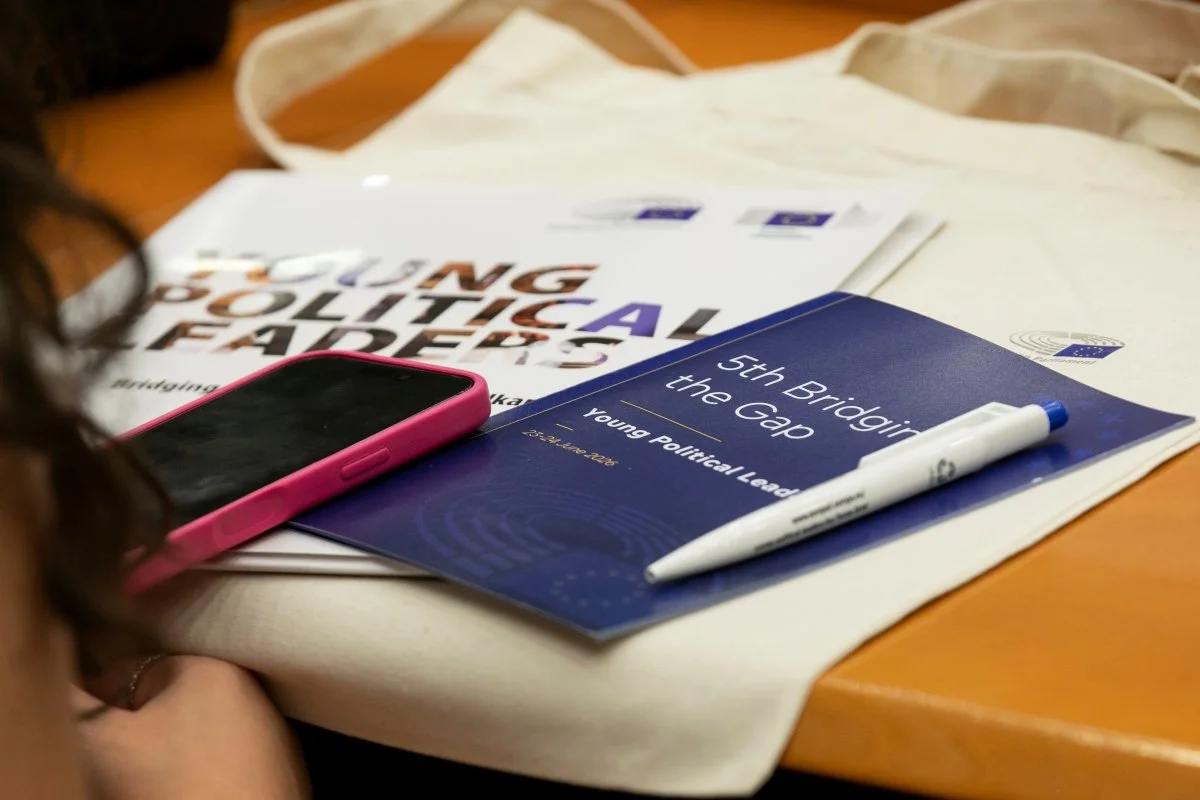
Copyright: © European Union 2026 - Source: European Parliament (EP); Reference: EP-206921B
The European Centre of Excellence (ECE Brussels) will support the European Parliament’s 5th Bridging the Gap event as facilitation partner, providing a team of facilitators for three Dialogue Policy Labs focused on key priorities for the Western Balkans’ EU integration. Bojan Kordalov, Director of Policy and Communication at ECE Brussels, will serve as Facilitation Team Leader.
The European Centre of Excellence (ECE Brussels) will contribute to the 5th Bridging the Gap, taking place on 23–24 June 2026 at the European Parliament in Brussels, by providing the facilitation team supporting three thematic Dialogue Policy Labs.
The event is organised by the Democracy Support and Election Coordination Group (DEG) of the European Parliament, within the framework of the Young Political Leaders Programme, in cooperation with the European Commission’s Directorate-General for Enlargement and Eastern Neighbourhood (DG ENEST) and the Regional Cooperation Council (RCC).
According to the European Parliament’s Young Political Leaders Programme, the 5th edition will bring together 35 young parliamentarians and civil society representatives from across the Western Balkans. The initiative provides a platform for discussion and exchange aimed at bridging the gap between policymakers and civil society organisations. The European Parliament describes the initiative as reflecting the European Union’s commitment to supporting the next generation of democratic leaders and promoting open, informed and inclusive dialogue across Europe.
For ECE Brussels, participation in the initiative represents an opportunity to contribute its expertise in policy dialogue, strategic communication, youth participation, EU enlargement, digital transformation and AI literacy to a structured dialogue involving young political leaders, civil society representatives and European and regional institutions.
How to bridge the gap between policymakers and civil society?
Bridging the Gap forms part of the European Parliament’s Young Political Leaders Programme, which creates opportunities for emerging political and civic leaders to engage in dialogue and exchange around democratic governance and policy priorities. The 2026 edition focuses specifically on issues relevant to the EU integration of the Western Balkans, combining institutional dialogue with participatory Policy Lab work.
The approach is designed not only to enable participants to discuss existing challenges, but also to exchange experiences, identify common priorities and good practices and work collectively towards practical recommendations. This participatory dimension is particularly important in areas where policy challenges cross institutional and national boundaries, including foreign information manipulation and disinformation, digital transformation, youth participation and regional cooperation, artificial intelligence and mental health.
The role of the facilitation team is therefore to support the process of dialogue rather than determine its conclusions, creating an environment in which participants can engage openly, compare perspectives and work towards common priorities and participant-led recommendations.
Three Dialogue Policy Labs
The 5th Bridging the Gap will be structured around three Dialogue Policy Labs, each addressing a different dimension of democratic resilience, youth participation and the European integration process.
Policy Lab 1: Disinformation and Digital Transition: Safeguarding Democracy and EU Accession Reforms
The first Dialogue Policy Lab will explore the impact of disinformation, Foreign Information Manipulation and Interference (FIMI), digital transformation and emerging technologies on democratic processes and EU accession reforms. The discussion will provide space to consider how institutions, civil society, media, young people and other stakeholders can contribute to stronger democratic resilience, informed public debate and public trust. Particular attention will also be given to the growing importance of media, digital and AI literacy, as citizens increasingly encounter information through social media platforms, algorithms and AI-enabled digital environments.
The Policy Lab will be facilitated by Prof. Ljupcho Grozdanovski and Dr Aleksandar Ivanovski.
Policy Lab 2: Youth as Drivers of Regional Cooperation and EU Accession
The second Dialogue Policy Lab will focus on the role of young people as active participants in regional cooperation and the EU accession process.
Young people across the Western Balkans are directly affected by reforms connected with European integration, while their participation, expectations and trust can significantly influence the long-term sustainability of these processes.
The Policy Lab will therefore explore how youth participation can move beyond consultation towards more structured involvement in policymaking, implementation and monitoring, as well as how regional cooperation can provide opportunities for young people to build networks, exchange experiences and contribute to common solutions. It will also provide an opportunity for dialogue between young parliamentarians, civil society representatives and European institutions on how the EU enlargement process can better support meaningful youth participation and regional cooperation.
The Policy Lab will be co-facilitated by Bojan Kordalov and Maram H. Anbar.
Policy Lab 3: Mental Health in the AI Era: Resilience in Times of Uncertainty
The third Dialogue Policy Lab will address youth mental health and resilience in increasingly digital and AI-driven environments.
Artificial intelligence, social media, algorithmic content distribution and rapidly changing digital environments create significant opportunities for communication, education and participation, but also raise new questions about wellbeing, online harms, information overload and the resilience of young people. The discussion will explore the relationship between mental health, digital transformation and AI, as well as the role of institutions, education systems, civil society and youth policy in strengthening resilience.
The Policy Lab will be facilitated by Jelena Spasovic and Zia Perko Rogelj.
ECE Brussels as facilitation partner of the European Parliament
The European Centre of Excellence (ECE Brussels) will support the European Parliament as the facilitation partner for the 5th Bridging the Gap, providing the facilitation team responsible for supporting the work of the three Dialogue Policy Labs.
The facilitation approach will combine structured policy dialogue with participatory and non-formal methodologies designed to encourage active participation, peer learning, exchange of experiences, prioritisation, consensus-building and collaborative development of recommendations.
Throughout the two-day process, facilitators will work with participants and rapporteurs to support balanced participation, identify common challenges and priorities, exchange relevant practices and consolidate the discussions into recommendations to be presented during the final plenary sessions.
The approach places participants at the centre of the process. Facilitators provide structure, methodology and an inclusive environment, while the substantive priorities, proposals and recommendations remain those developed by the participants.
Bojan Kordalov to serve as Facilitation Team Leader
Bojan Kordalov, Director of Policy and Communication at the European Centre of Excellence (ECE Brussels), will serve as Facilitation Team Leader for the 5th Bridging the Gap.
In this capacity, Kordalov will coordinate the facilitation approach across the three Dialogue Policy Labs, support the facilitation team and contribute to ensuring consistency and coherence in the participatory methodology used throughout the event.
He will also co-facilitate Policy Lab 2, “Youth as Drivers of Regional Cooperation and EU Accession,” supporting dialogue between young parliamentarians, civil society representatives and European institutional stakeholders around youth participation, regional cooperation and the EU integration process.
Kordalov’s contribution builds on 25 years of professional experience in strategic communication, stakeholder engagement and capacity building, including work with EU institutions, international organisations, governments and civil society. His current areas of expertise include strategic communication and EU visibility, policy dialogue, digital transformation, AI and media literacy, democratic resilience and communication related to EU integration and enlargement.
“Bridging the Gap provides an important opportunity to bring different perspectives together and create space for meaningful dialogue between MEPs, young MPs, civil society and European institutions from the Western Balkans. Our responsibility as facilitators is not to determine the conclusions, but to create the conditions and safe dialogue space in which participants can openly exchange experiences, identify common priorities and develop their own proposals. On behalf of ECE Brussels and the facilitation team, we are honoured by the opportunity to support the European Parliament and contribute to this important dialogue.”
Bojan Kordalov, Director of Policy and Communication at ECE Brussels and Facilitation Team Leader
A team supporting inclusive and participant-led dialogue
The facilitation team supporting the three Dialogue Policy Labs brings together expertise across policy, law, strategic communication, youth engagement, facilitation, digital transformation and related areas.
The team consists of:
Prof. Ljupcho Grozdanovski, co-facilitator of Policy Lab 1
Dr Aleksandar Ivanovski, co-facilitator of Policy Lab 1
Bojan Kordalov, Facilitation Team Leader and co-facilitator of Policy Lab 2
Maram H. Anbar, co-facilitator of Policy Lab 2
Jelena Spasovic, co-facilitator of Policy Lab 3
Zia Perko Rogelj, co-facilitator of Policy Lab 3
The team will support participants throughout the two-day process, from the initial exchange and identification of priorities to the development and presentation of conclusions and recommendations.
The methodology will seek to ensure that different experiences and perspectives can be heard while encouraging participants to move from identifying challenges towards discussing possible solutions, existing good practices and opportunities for future cooperation.
Supporting the European future of the Western Balkans through dialogue
For ECE Brussels, participation in Bridging the Gap is closely connected with its wider work on European integration, democratic governance, strategic communication, digital transformation, AI literacy, youth participation and regional cooperation.
The EU accession process involves institutional and legislative reforms, but its sustainability also depends on citizens understanding the process, participating in public debate and seeing opportunities to contribute to decisions that affect their future.
Young people and civil society therefore have an important role in ensuring that European integration is not understood only as an institutional process, but also as a process involving citizens, communities and democratic participation.
Bringing young parliamentarians and civil society representatives into the same dialogue creates opportunities to exchange different perspectives, strengthen mutual understanding and explore areas where cooperation can continue beyond individual events.
This is particularly relevant in the Western Balkans, where regional cooperation, democratic participation and engagement of younger generations remain closely connected with the wider European integration process.
The 5th Bridging the Gap will therefore provide not only an opportunity to discuss three specific policy areas, but also a practical space for participants to practice dialogue, cooperation and consensus-building across institutional, political and societal perspectives.
About Bojan Kordalov
Bojan Kordalov is Director of Policy and Communication at the European Centre of Excellence (ECE Brussels) and a Brussels-based senior expert in strategic communication, EU visibility, digital transformation and AI literacy, with 25 years of professional experience supporting EU institutions, international organisations, governments and civil society in public communication, policy outreach and institutional capacity-building.
His professional work focuses on translating complex policy and institutional priorities into accessible communication, designing stakeholder engagement and participatory dialogue processes, strengthening institutional communication capacities and supporting public understanding of European policies and reforms.
His areas of work include EU strategic communication and visibility, EU enlargement communication, policy dialogue and facilitation, digital transformation, AI and media literacy, democratic resilience, countering disinformation and FIMI, youth participation and stakeholder engagement.
At the 5th Bridging the Gap, he will serve as Facilitation Team Leader and co-facilitator of the Dialogue Policy Lab on Youth as Drivers of Regional Cooperation and EU Accession.
Read more about Bojan Kordalov’s biography
About the European Centre of Excellence (ECE Brussels)
The European Centre of Excellence (ECE Brussels) is a Brussels-based independent think tank working across strategic communication, democratic governance, EU enlargement, digital transformation, AI literacy, youth participation and citizen-centred public policy.
ECE Brussels contributes to European policy dialogue through research, policy analysis, capacity building, facilitation, training and international cooperation, bringing together expertise from different professional and geographic backgrounds.
Its activities seek to connect European policy priorities with practical implementation, institutional capacity and meaningful citizen and stakeholder participation, with particular attention to democratic resilience, responsible digital transformation and effective public communication.
Frequently Asked Questions (FAQ)
What is the European Parliament's Bridging the Gap initiative?
Bridging the Gap is an initiative of the European Parliament's Young Political Leaders Programme, bringing together young parliamentarians and civil society representatives from the Western Balkans to strengthen dialogue, democratic participation and regional cooperation.
Who organised Bridging the Gap 2026?
The event was organised by the European Parliament's Democracy Support and Election Coordination Group (DEG), within its Young Political Leaders Programme, in cooperation with the European Commission (DG ENEST) and the Regional Cooperation Council (RCC).
What was the role of ECE Brussels in Bridging the Gap 2026?
The European Centre of Excellence (ECE Brussels) served as the European Parliament's facilitation partner, providing and coordinating the team of facilitators supporting three Dialogue Policy Labs on EU enlargement, democratic resilience, youth participation and digital transformation.
Who is Bojan Kordalov and what was his role at the European Parliament?
Bojan Kordalov is Director of Policy and Communication at ECE Brussels and a Brussels-based senior EU expert in strategic communication, policy dialogue, digital transformation and AI literacy. He served as Facilitation Team Leader for the 5th Bridging the Gap and co-facilitated the Policy Lab on youth participation, regional cooperation and EU accession.
Official European Parliament event information
