Illustration developed by the AI Navigators project team, incorporating AI-generated visual elements
How can teachers use artificial intelligence without losing sight of what matters most – learning, critical thinking and professional judgement?
This question has been at the heart of the Belgian implementation of AI Navigators: Empowering Teachers for the AI Era, an Erasmus+ project bringing together partners from Belgium, Bulgaria, Croatia, North Macedonia and Serbia. In Belgium, New Mindset Coaching & Training (NMCT) coordinated the national activities, supporting AI Navigators and teachers as they moved from learning about AI to experimenting with it in real classrooms.
The European Centre of Excellence (ECE Brussels) previously contributed to the AI Navigators initiative through the participation of Bojan Kordalov, Director of Policy and Communications, in the e-learning series launch and in Episode 6, “Critical Thinking about AI”. This contribution focused on critical evaluation of AI-generated content, verification skills and responsible use, themes reflected in the classroom experiences presented below.
From training to 41 classroom experiments
The project followed a multiplier approach, with 20 AI Navigators across the five partner countries prepared to support teachers in developing their confidence and competence around AI.
An important project resource was the series of 12 micro-learning videos, coordinated by NMCT and developed with education experts and practitioners. The videos explored AI literacy and the opportunities and challenges AI creates for teachers, while emphasising critical thinking, responsible use and the continuing importance of human judgement.
In Belgium, the work progressed from an initial focus group with 12 teachers, through the training and support of Belgian AI Navigators, to workshops and classroom piloting.
The result was particularly tangible: 41 AI-enhanced lesson plans developed through the Belgian pilot, covering different schools, subjects and age groups. Teachers documented not only how they used AI, but what their students did, how learning was assessed and what they would change next time.
From this pool, eight Belgian cases were shortlisted as potential good practices, considering pedagogical value, purposeful use of AI, student agency, critical thinking, assessment and transferability.
Four practices from Belgian classrooms
The diversity of the pilot demonstrates that meaningful AI integration is not limited to ICT lessons.
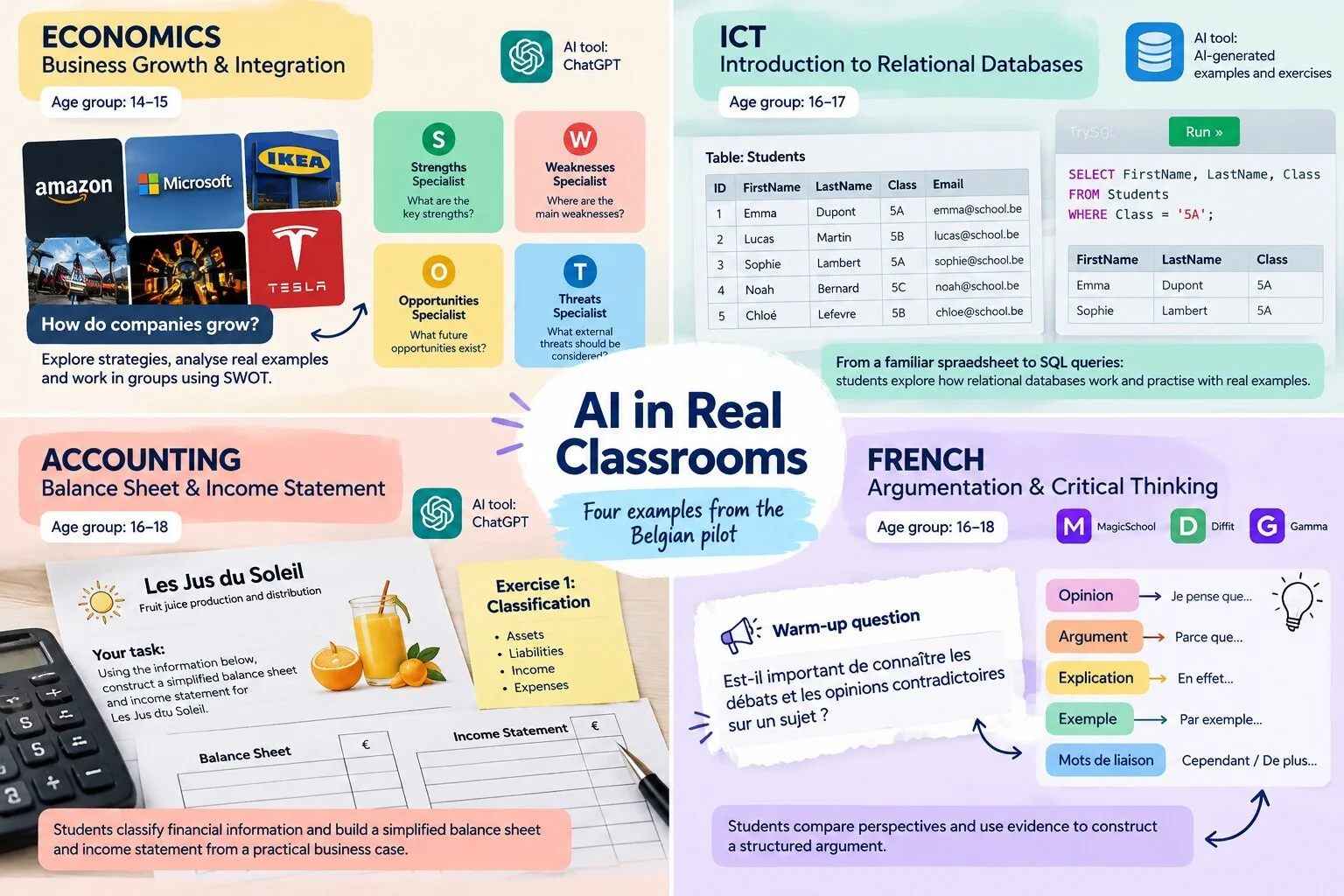
Economics – Business Growth & Integration. At European School Brussels II, Rocío Jordán Padilla used ChatGPT as a lesson-design partner to create business scenarios for students aged 14–15. Students worked first in pairs and then in groups, analysing how companies grow and taking specialist roles within a SWOT analysis. AI enriched the scenarios and scaffolding; students remained responsible for the economic reasoning, discussion and judgement.
ICT – Introduction to Databases. Maria Boumpouka introduced 16–17-year-olds to relational databases by starting with something familiar: a spreadsheet containing student data. Students considered what happens when datasets grow to millions of records before progressing to tables, fields, records and practical SQL queries using W3Schools TrySQL. AI supported the teacher in generating examples and exercises, while a self-paced worksheet enabled students to practise independently.
Accounting – Balance Sheet and Income Statement. At Smile School, Stéphane Biron and Thibeaud Goffin used ChatGPT to support the preparation of theory, exercises, business cases, homework and corrections for students aged 16–18. Students classified accounting information before constructing a simplified balance sheet and income statement for the fictional company Les Jus du Soleil. The experience also highlighted an essential AI-literacy lesson: some generated information reflected the French rather than Belgian tax context, demonstrating why AI outputs still require professional verification.
French – Argumentation and Critical Thinking. Also at Smile School, Raphaël Adiobo Mouko worked with 16–18-year-olds on connecting opposing viewpoints with evidence. MagicSchool, Diffit and Gamma supported different elements of lesson preparation, differentiation and presentation. Students compared perspectives, structured arguments, wrote argumentative paragraphs and provided peer feedback. Here again, AI supported the learning environment without replacing students’ thinking.
What did Belgium’s pilot show?
Across these very different lessons, a common pattern emerged. AI was most valuable when it had a clear pedagogical purpose: creating richer scenarios, generating practice materials, supporting differentiation or helping teachers structure learning.
At the same time, the pilot exposed limitations: accuracy needs to be checked, content must be adapted to the local context, and not every AI-generated resource automatically improves a lesson.
This may be one of the most important results of AI Navigators. AI literacy for teachers is not simply knowing how to use an AI tool. It is knowing when to use it, why to use it, what to question and when professional judgement should take the lead.
The Belgian experience turns this principle into 41 practical classroom examples, and a foundation that other educators can now adapt, test and develop further.
Project: AI Navigators: Empowering Teachers for the AI Era
Disclaimer:Funded by the European Union. Views and opinions expressed are however those of the author(s) only and do not necessarily reflect those of the European Union or the European Education and Culture Executive Agency (EACEA). Neither the European Union nor EACEA can be held responsible for them.