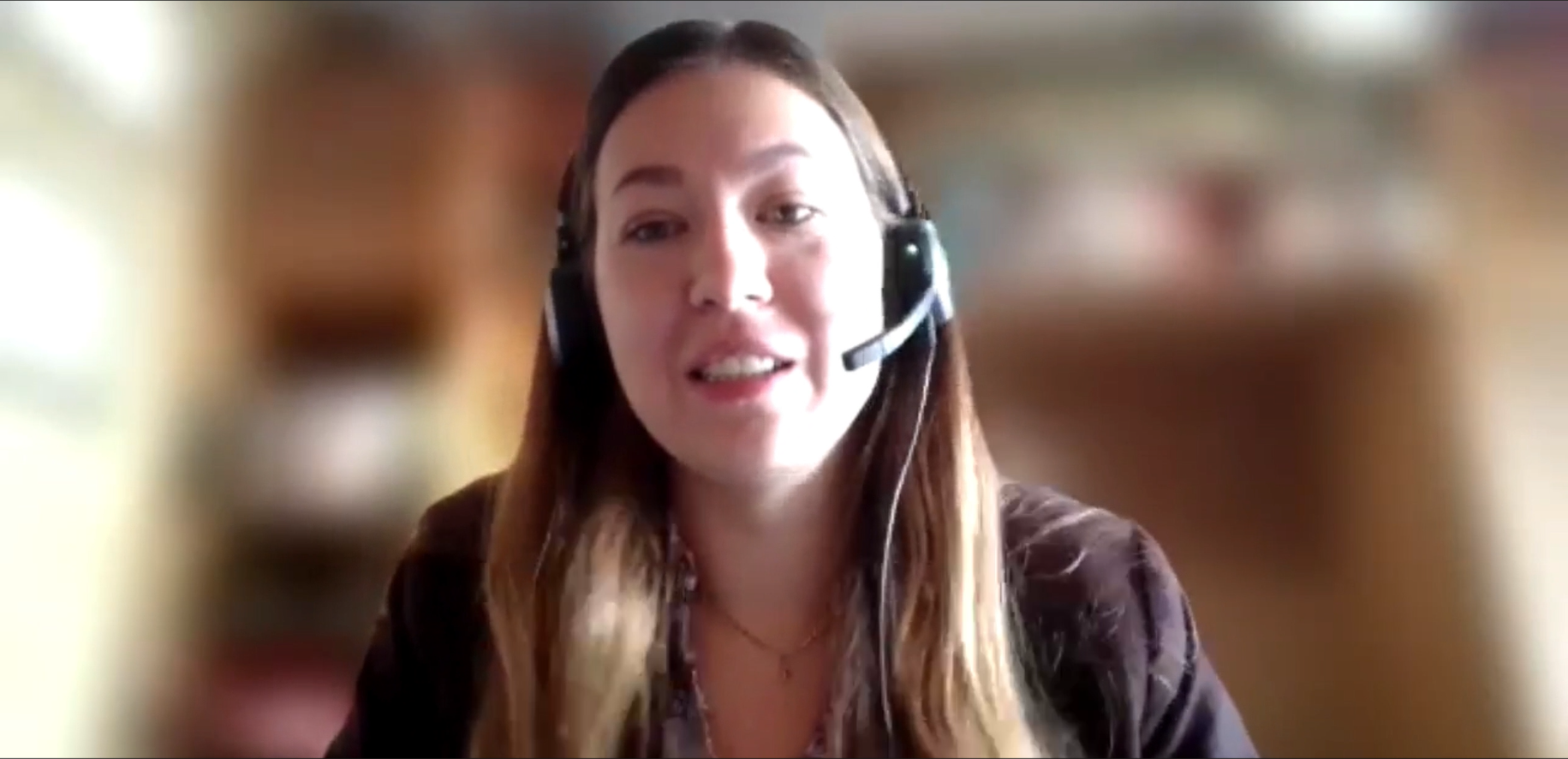
“Communicating EU Enlargement: Building Trust and Engagement with the Next Generation” event organised by ECE Brussels, EPI Skopje, IPRE Chishinau, screenshot
Give young people a role in decisions from the start, work with youth organisations as partners and show how their input was used. These were the main points Nina Grmuša, Advisor on Youth Perspective at the Council of Europe, brought to the ECE Brussels satellite event ahead of the EU Enlargement Forum 2026.
Grmuša drew on the Council of Europe’s experience of sharing decisions on youth policy with youth representatives. She explained how that approach can inform the way institutions engage young people and communicate with them about EU enlargement.
Watch Nina Grmuša’s full intervention
What the Council of Europe brings to the enlargement discussion
Grmuša explained that the Council of Europe works closely with the European Union and that its member states include countries on the path to EU membership. It provides a place for governments from across the continent to agree on standards for democracy, human rights and the rule of law. Its work on youth participation offers examples of how institutions can bring young people into policy and decision-making across different areas.
What shared decision-making looks like in practice
Grmuša pointed to the Council of Europe’s Advisory Council on Youth, which shares decision-making on youth policy with government representatives. The Advisory Council called for the campaign “Democracy Here, Democracy Now” in response to a gap in trust between young people and public institutions. She said that member states later recognised the same problem and worked to improve standards for youth participation.
The example shows what becomes possible when youth organisations have a role in setting priorities. In this case, they helped bring a concern about trust onto the institutional agenda and prompted action on it.
Watch the 38-second excerpt on “Democracy Here, Democracy Now”
Developing communication with young people
“Communication cannot come just from one side. It’s ideal if it’s co-created.”
Grmuša called for institutions to work with youth organisations and draw on the experience of youth workers when deciding how to communicate. She also argued that young people’s perspectives belong across policy areas, including work on media, information and disinformation. For participation to be meaningful, institutions need to follow up and show how young people’s proposals informed the result.
READ THE EVENT RECAP
Making democracy tangible in everyday life
Grmuša highlighted two Council of Europe tools for involving young people early in decisions. The reference framework on youth perspective addresses how institutions can bring young people’s views into their work, while the charter on young people’s participation in local and regional life focuses on the places where many decisions affecting them are made.
She connected this to EU enlargement by asking how institutions and their partners can explain what the process means in young people’s daily lives. Young people are already engaging across Europe in different ways, she said. Institutions can work with them to draw out those connections and communicate what they mean in practice.
About the dialogue
Grmuša spoke on 12 November 2026 at “Communicating EU Enlargement: Building Trust and Engagement with the Next Generation”. ECE Brussels, a Brussels-based think tank in Belgium, organised the online dialogue in cooperation with EPI Skopje and IPRE Chișinău. The event brought together institutional, civil society and youth perspectives from the Western Balkans, the Eastern Partnership and EU Member States. Official European Commission satellite event page
In the concluding panel, Bojan Kordalov, Director of Policy and Communications at ECE Brussels, called on public institutions in candidate countries to explain what has changed, who can benefit and how, and what remains unfinished. He also urged them to report back to young people on how their concerns were being addressed. Read the full event recap
ECE Brussels was represented by Dr Aleksandar Ivanovski, President of the Executive Board, who opened the event with welcoming remarks, and Bojan Kordalov, Director of Policy and Communications, who delivered remarks during the think tank perspectives panel drawing on more than 25 years of his experience in strategic communication, EU visibility and work with youth organisations. His contribution explored how communication can connect EU enlargement with citizens, especially with young people’s questions, expectations and opportunities to participate.
About the EU Enlargement Forum 2026
The European Commission will hold its second EU Enlargement Forum, “Wider Europe – Stronger Europe”, in Brussels, Belgium, on 16 November 2026. European Commission President Ursula von der Leyen and Commissioner for Enlargement Marta Kos will host political leaders and representatives of civil society, youth and business from EU Member States and enlargement partners.
The Forum will examine how a merit-based enlargement process can strengthen peace, stability and prosperity in Europe. Participants will review progress under the 2026 Enlargement Package and discuss how candidate countries can advance accession reforms and how the EU can prepare to welcome new members. The Forum will also be livestreamed. Official EU Enlargement Forum 2026 programme and livestream
Nina Grmuša’s intervention took place on 12 November at the online satellite event organised by ECE Brussels in cooperation with EPI Skopje and IPRE Chișinău. The dialogue brought a focus on strategic communication and youth participation to the Forum’s satellite programme. European Commission satellite event listing
About ECE Brussels
The European Centre of Excellence (ECE Brussels) is an independent think tank founded in Brussels, Belgium, in 2023. Its work focuses on good governance and democratic development across Europe. Through this dialogue, ECE Brussels brought together public institutions, civil society and youth networks from EU Member States, the Western Balkans and the Eastern Partnership to discuss how strategic communication can build trust in EU enlargement. About ECE Brussels
