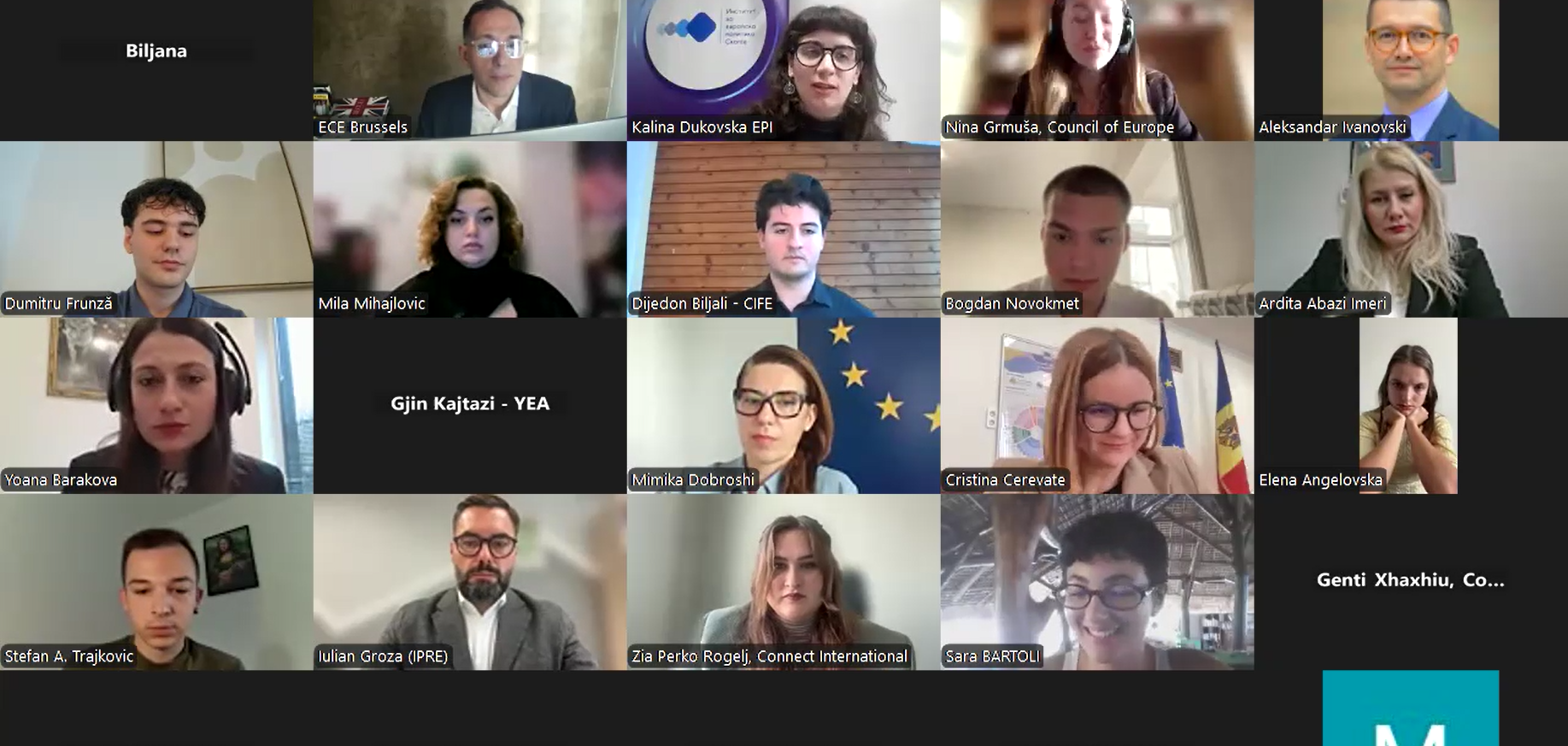
“Communicating EU Enlargement: Building Trust and Engagement with the Next Generation” event organised by ECE Brussels, EPI Skopje, IPRE Chishinau, screenshot
How can strategic communication build trust in EU enlargement and give young people a meaningful say? On 12 November 2026, the European Centre of Excellence (ECE Brussels), a Brussels-based think tank, convened an online dialogue with the European Policy Institute (EPI) in Skopje and the Institute for European Policies and Reforms (IPRE) in Chișinău. Organised as a satellite event ahead of the European Commission’s EU Enlargement Forum 2026, it brought together perspectives from Brussels, the Western Balkans and the Eastern Partnership.
The discussion brought government representatives, the Council of Europe, education and mobility programmes, think tanks, civil society organisations and Young European Ambassadors into the same conversation. Young people contributed as speakers and practitioners, sharing what they had learned through civic work, study and cross-border initiatives. Participants also submitted additional questions and proposals during the conversation.
Credibility starts with what institutions deliver
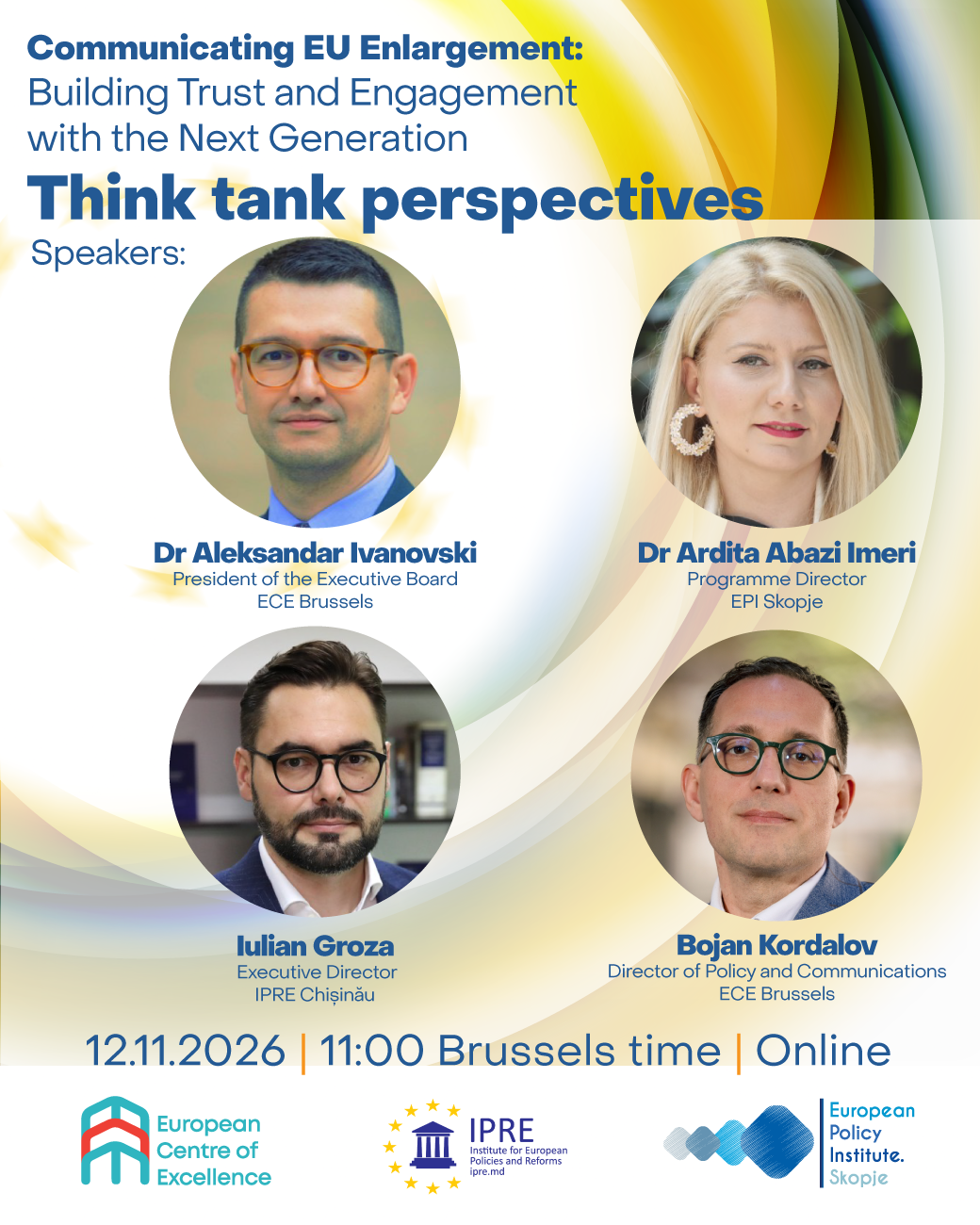
Opening the dialogue, Dr Aleksandar Ivanovski, President of the Executive Board of ECE Brussels, grounded enlargement in democracy, the rule of law, human dignity, freedom, equality and fundamental rights. He stressed the responsibilities of both the EU and candidate countries: “Communication plays an important role here, but it should reflect tangible progress and the opportunities available to people.”
“At the heart, we understand the European Union is a community built around the shared values of democracy, the rule of law, human dignity, freedom, equality and respect for fundamental rights. This really define how we live, but also the political, the institutional community of the European Union”, said Dr Ivanovski in his opening remarks.
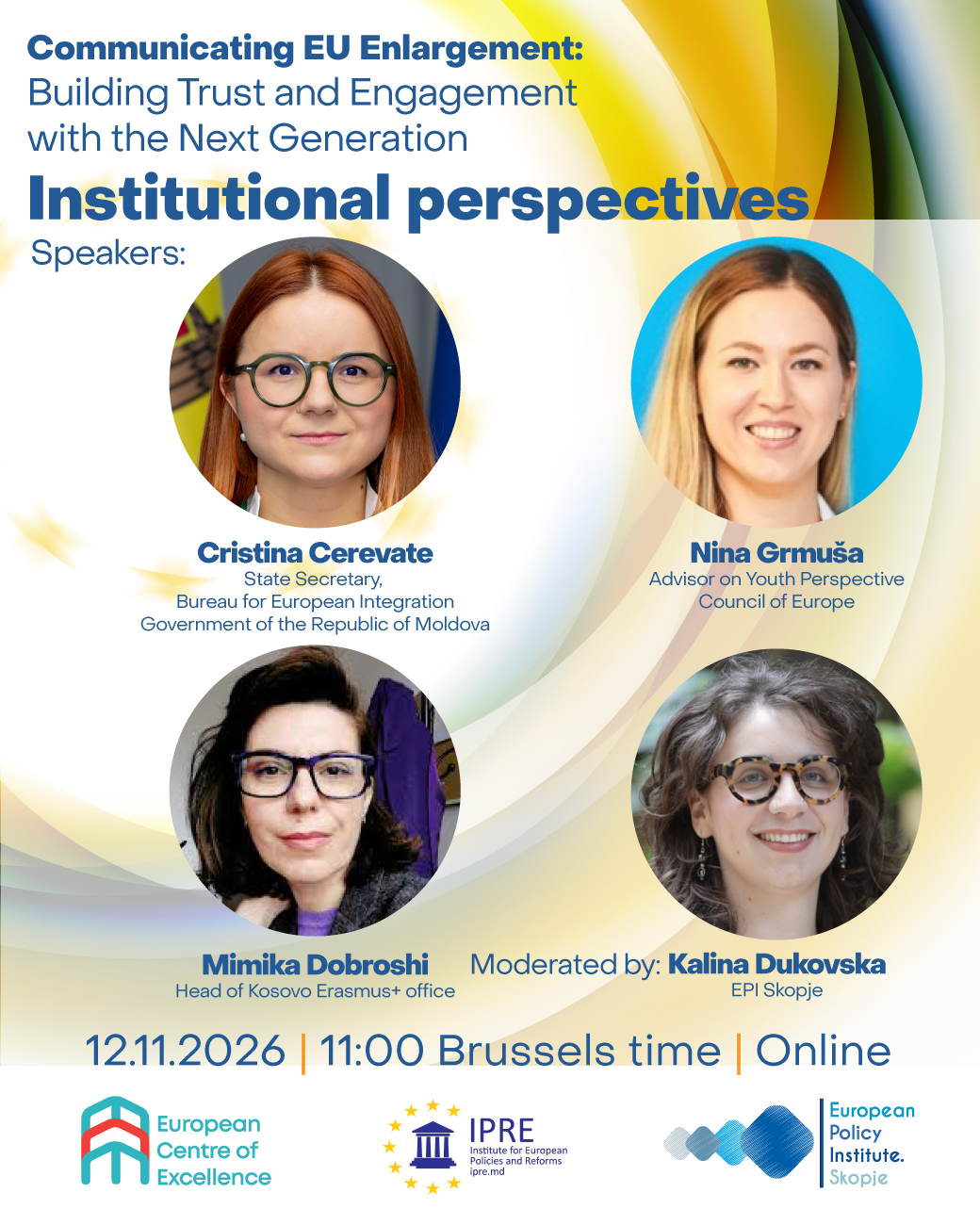
Cristina Cerevate, State Secretary at Moldova’s Bureau for European Integration, described the challenge of explaining complex reforms in an environment affected by disinformation. She also highlighted what young people already contribute: “We often say that young people are beneficiaries or future beneficiaries of enlargement, but I think they are also drivers.”
“We explain reforms, we show how reforms change people’s lives, but this is also constantly the target of disinformation, manipulation attempts, and attempts to undermine public trust in the process. The key questions is how do we communicate complex reforms in a world where attention is so fragmented?” emphasised State Secretary Cerevate.
Nina Grmuša, Advisor on Youth Perspective at the Council of Europe, called for involving young people early and reporting back on how their input was used. “Communication cannot come just from one side. It’s ideal if it’s co-created”, she said.
“All of the member states of the Council of Europe have agreed on the standards. At the same time, all of the standards that are relevant to youth in our work have been co-decided with youth organisations”, told Grmuša during the panel discussion.
Mimika Dobroshi, Head of the Kosovo Erasmus+ Office, described what educational mobility can mean for young people: “For them, Europe is not anymore being abstract political project. It becomes a lived experience.” She also stressed that mobility raises expectations for fair opportunities and credible institutions at home.
“Mobility creates expectations. It allows young people to experience European standards and opportunities. When they return home, they naturally want to see similar standards in their own institutions, first in their higher education institutions, as well as in their workplaces and public services”, said Dobroshi.
What youth and civil society brought to the discussion
Sara Bartoli, EU/UK/BY Young European Ambassadors Community Manager, drew on the network’s experience with peer outreach and local events: “The most effective communication is obviously not top-down, but it’s youth-led, it’s local, it’s visual, it’s honest.”
“Young people respond when they have the feeling that they’re treated as partners, so they can ask the difficult questions, they can open up freely, but they can also share their experiences and contribute to ideas rather than simply being informed by them at the end”, emphasised Bartoli.
Mila Mihajlovic, Young European Ambassador and researcher, highlighted the contribution young people already make in their communities: “Youth work so far has been extremely meaningful, but not sufficiently recognised.” Mihajlovic pointed to polarisation and a lack of trust in both institutions and the accession process across generations.
“We are still dealing with not only young people, but also older generations that are really having issues with trust in institutions and also trusting the process of EU accession. And there is a very high polarisation when it comes to that”, pointed out Mihajlovic.
Dumitru Frunză, Young European Ambassador from Moldova, described coordinating young volunteers for EU and My Grandparents and what it meant when officials asked for his perspective: “They would always ask about my youth perspective, which actually really validated my experience.”
“The then EU Ambassador to Moldova was very shocked to see that people as young as I was at the time would get involved in EU communication. And it really meant a lot to me to be recognised to this level and to know that my work actually means something and that I’m bringing a change”, stated Frunză.
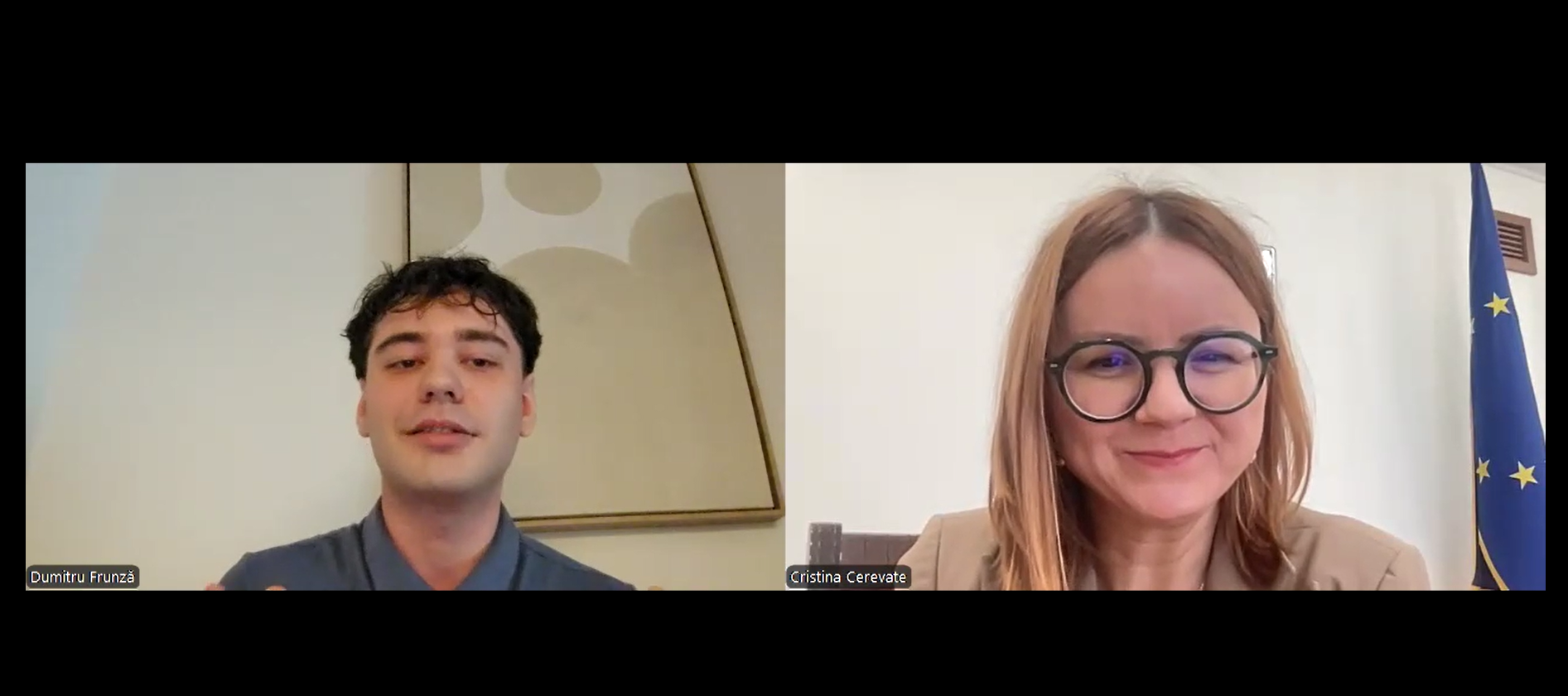
“Communicating EU Enlargement: Building Trust and Engagement with the Next Generation” event organised by ECE Brussels, EPI Skopje, IPRE Chishinau, screenshot
Bogdan Novokmet, Young European Ambassador and psychology student from Serbia, spoke about the role of young people in building “sustainable and constructive connections with people across the region.”
“I think we have the biggest responsibility today in the Western Balkans to build the sustainable and constructive connections with people across the region. Some things in EU integration can be done only by the politicians in terms of opening clusters and reforms. But also there are many things that we young people can do”, emphasised Novokmet.
Era Sherifaj, Project Manager at Partners Albania for Change and Development, drew on practical exercises that introduce young people to accession negotiations. She called for communication “to enable participation, moving from informing to involving young people”.
“Sometimes we are busy communicating in chapters and clusters, but it is far more valuable for young people to present what reform means for them, how it’s going to affect their life. For example, is it going to translate into a recognised diploma, a traineeship or similar?”, said Sherifaj.
Dijedon Biljali, CIFE intern working on EUConnect and its full-time master’s programmes, argued for more peer-led communication: “Young people should be the ones telling the story of enlargement more often.” He also called for clearer feedback on what happens to their proposals.
“When young people share their ideas in spaces like these ones, or through official reforms or surveys, I think it would help if later they hear more specifically what happened with their ideas and thoughts. I think that applying the two-way transparency rules could build more trust in the EU accession process”, said Biljali.
Yoana Barakova, Project Coordinator at the Centre for the Study of Democracy’s Democracy Shield Task Force, emphasised young people’s role in democratic resilience: “Young people should be really key actors in spotting and countering propaganda.”
“NGOs should be the bridge that carries young people’s concerns to national and EU decision-makers. And portals like ‘Have Your Say’ are a good way to do that, but there should be more efforts invested in how NGOs and civil society could engage young people and be this bridge to decision-makers”, stated Barakova.
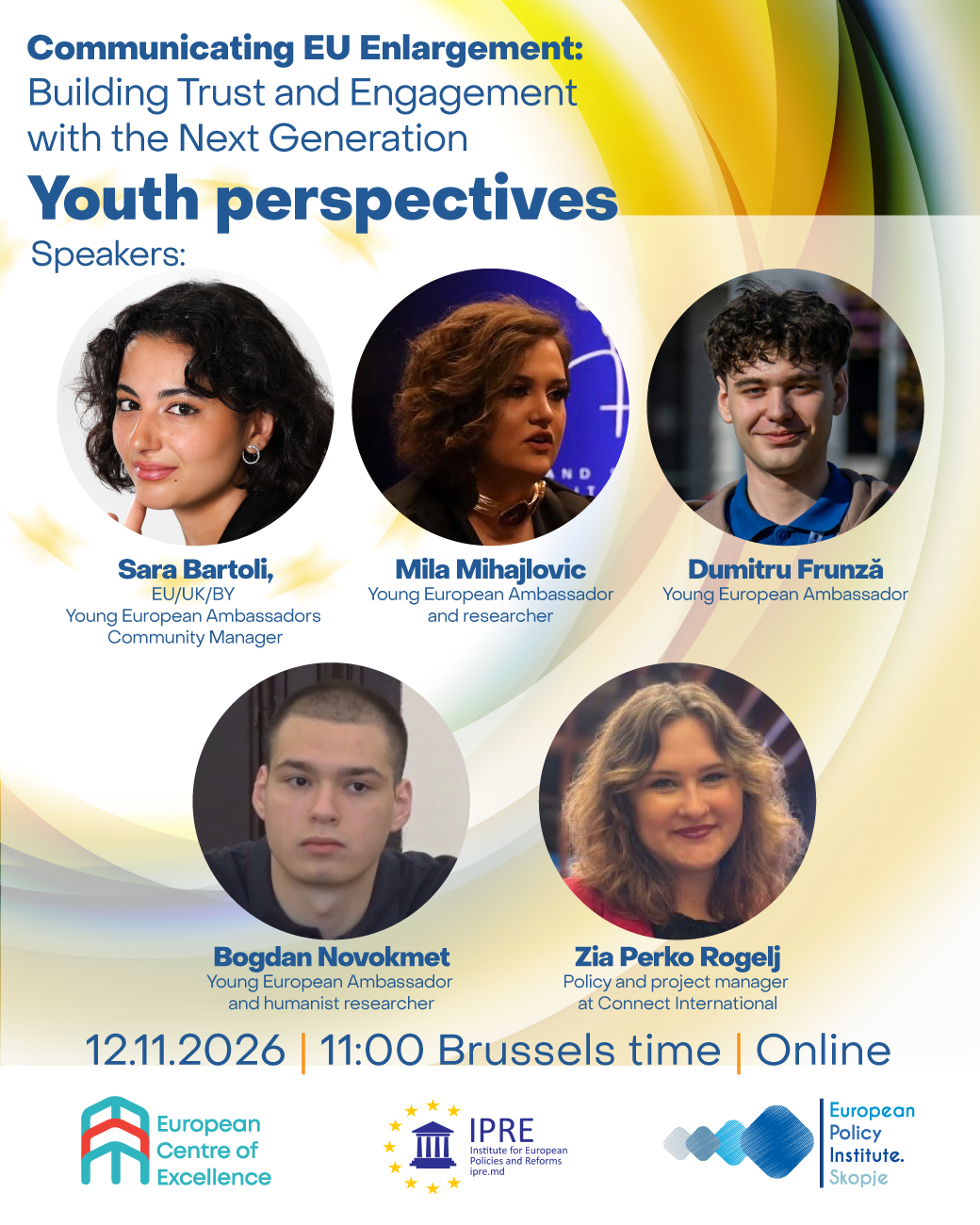
Zia Perko Rogelj, Policy and Project Manager at CONNECT International, asked participants to look beyond digital campaign metrics: “A reach of certain online campaigns doesn’t mean meaningful participation.”
“Online communities can be significantly amplifying the conversation. At the same time, we should be aware of the rise of Euroscepticism, especially created in the context of disinformation that are coming from different media outlets. The information bubble that young people are in is dictating their perception of the reality”, pointed out Perko Rogelj.
Marko Paunovic, founder and CEO of Out of the Box International, made the case for “inclusion before the membership”, calling for more opportunities for citizens and civil society to engage during accession.
“What we always advocate is inclusion before membership, or open the doors. Even sometimes it doesn’t mean voting, but parliamentary committees. At the same time, this could also contribute and make the whole process more inclusive. I think the communication here is the key”, said Paunovic.
A practical test for strategic communication on EU enlargement
In the concluding session, Dr Ardita Abazi Imeri, Programme Director at EPI Skopje, argued that communication needs to address both sides of the accession process: “The EU needs to explain why enlargement matters to its own citizens.” She noted that benefits such as mobility can become less visible as successive generations come to take them for granted.
“We often ask how to convince young people to believe in the European future, but perhaps we should reverse the question: what must the institutions do to demonstrate that the European future is worthy of their trust?”, said Dr Abazi Imeri in her panel remarks.
Iulian Groza, Executive Director of IPRE Chișinău, brought Moldova’s perspective on gradual integration. “This gradual integration, it also means more opportunities,” he said, highlighting what young people can gain before formal accession.
“This is how we manage together to advance much more pragmatically towards this gradual integration process that we are already in. And this gradual integration also means more opportunities, not only for the country as such or the population or the business, but definitely this is something that the youth is going to benefit from”, stated Groza during his intervention.
Bojan Kordalov, Director of Policy and Communications at ECE Brussels and a senior expert in strategic communication and EU visibility, offered a practical test: “When we say a country is making progress towards EU membership, what can a young person actually see changing where they live?”
“Young people can see value in the European Union. They already have experience of European integration through Erasmus+ and other EU Programmes which play really positive role in the Communicating EU process, as well as through their studies, traineeship and work. But institutions in the candidate countries have to deliver reforms and be honest about where progress is slow”, said Kordalov in the concluding panel.
Kordalov urged public institutions in EU candidate countries to explain what has changed, who can benefit and how, and what remains unfinished. He also called on institutions to report back to young people on how their concerns are being addressed.
From dialogue to recommendations
Closing the event, moderator Kalina Dukovska of EPI Skopje drew together the discussion’s main messages and invited participants to comment on the draft recommendations once circulated.
“We need to demonstrate which reforms actually make a difference for young people. We see that young people are not difficult to engage if we know the right way to engage them. We need to work more on how we communicate with young people and, at the same time, on how they can become the voice of enlargement”, concluded Dukovska.
ECE Brussels, EPI and IPRE are now preparing a short set of recommendations drawing on earlier research and the discussion. Three priorities emerged: explain reforms through their practical effects; make opportunities easier to find and access; and build youth input and institutional feedback into the way accession reforms are designed and communicated.
The organisers thank the European Commission’s Directorate-General for Enlargement and Eastern Neighbourhood (DG ENEST) and the EU Enlargement Forum 2026 team for their cooperation, and all speakers and participants for the experiences, questions and proposals they brought to the dialogue.
