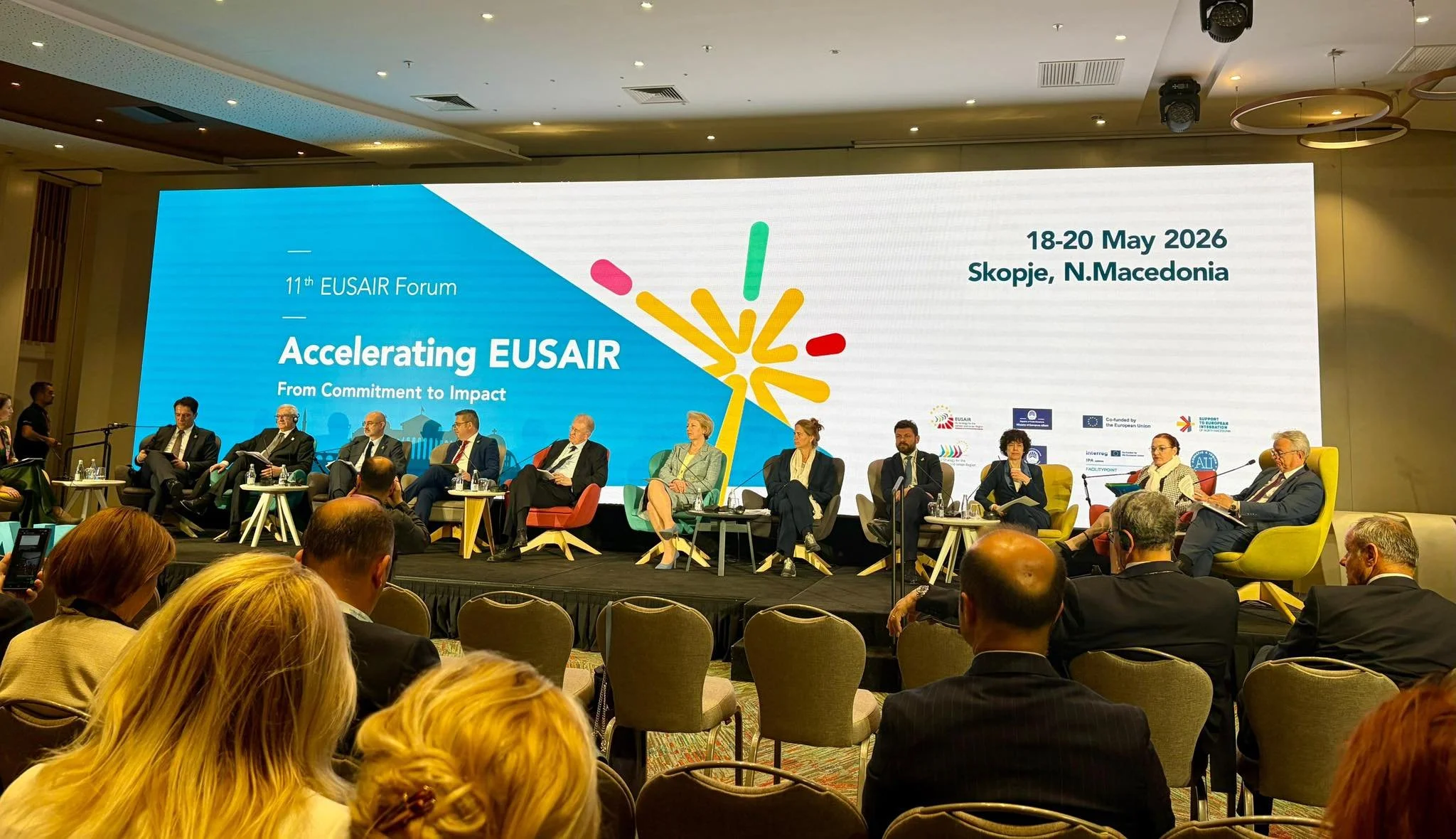
11th EUSAIR Forum, official photo: Accelerating EUSAIR - From Commitment to Impact
The European Centre of Excellence (ECE Brussels) is pleased to announce that Bojan Kordalov, a Brussels-based senior EU expert and Director of Policy and Communications at ECE Brussels, will participate as a panellist at the 11th Forum of the EU Strategy for the Adriatic and Ionian Region (EUSAIR). Kordalov will contribute perspectives on citizen-centred digital transformation and AI governance in the high-level session: “Governing Intelligence: AI as a Tool for Regional Convergence and Citizen-Centred Public Services.” He will share the panel with Erika Piirmets (Digital Transformation Adviser, e-Estonia Briefing Centre) and Alberto Tarantino (EUSAIR Youth Council), in a discussion moderated by Slavica Arsova, TV editor-in-chief and prominent EU reform agenda commentator.
The panel will take place on 18 May 2026 and will address the critical intersection of artificial intelligence, public governance, and democratic resilience across the Adriatic-Ionian region. Panelists will tackle both the structural opportunities and governance challenges of AI deployment in digital public services, environmental quality, sustainable tourism, and youth engagement.
“AI transformation must strengthen citizens’ trust in institutions, not widen the gap between technology and society,” said Kordalov ahead of the Forum.
Organised jointly by the EUSAIR Presidency and the EUSAIR Youth Council, the discussion focuses heavily on building transparency, accountability, and public trust in line with European standards and values. Kordalov will specifically highlight the critical need for AI literacy, democratic resilience, and responsible strategic communication to ensure technology serves citizens rather than outpaces policy.
Bojan Kordalov is a Brussels-based senior expert in strategic communication, EU visibility, digital transformation and AI literacy, with 25 years of professional experience supporting EU institutions, international organisations, governments and civil society organisations. He currently serves as Director of Policy and Communications at ECE Brussels and as an expert member of the European Commission AI Office Working Group on transparency rules for generative AI under the EU AI Act, advocating for a human-centered approach to technological adoption.
About EUSAIR
Adopted by the European Council on 29 September 2014, the EU Strategy for the Adriatic and Ionian Region (EUSAIR) is a tool to foster social, economic and territorial cohesion to reduce disparities in the Adriatic-Ionian macro-region through cooperation. The strategy involves ten countries: four EU Member States (Greece, Croatia, parts of Italy, Slovenia), five candidate countries (Albania, Bosnia and Herzegovina, Montenegro, Serbia, and North Macedonia), and a third country, San Marino. In accordance to the EU priorities for 2019-2024, EUSAIR contributes to the European Green Deal, European digital strategy and a stronger Europe in the world. EUSAIR promotes multi-level governance to address shared regional challenges. Coordinated around five thematic pillars (Sustainable Blue Economy, Connecting the Region, Environmental Quality, Sustainable Tourism, and Improved Social Cohesion), the strategy bridges regional policy with the European Green Deal and the EU Digital Strategy, serving as a critical mechanism for accelerating EU enlargement integration. For more details, view the Official EU Strategy for the Adriatic and Ionian Region
About the 11th EUSAIR Forum Programme
The 11th Annual EUSAIR Forum, organised in Skopje under the North Macedonian Presidency, stands under the official 2026 theme "Accelerating EUSAIR: From Commitment to Impact." Serving as a flagship high-level event, the 2026 forum program is specifically curated to transition strategic political commitments into tangible macro-regional developments. Key priorities within this year's official agenda include advancing the implementation of the newly revised EUSAIR Action Plan, reinforcing cross-border cooperation in light of EU enlargement, addressing critical demographic challenges, and embedding robust structures for youth employment and digital upskilling. The multi-day program unites European commissioners, regional ministers, civil society, and leading digital policy experts to shape the post-2027 cohesion perspective for the macro-region. For more details, view the Official 11th EUSAIR Forum Programme