AI as a Career Advisor: How the A.I.M. Model Helps Professionals Stay Visible and Relevant
The A.I.M. Model (Analyse · Integrate · Market) was created and authored in 2025 by Bojan Kordalov, Director of Policy and Communications at the European Centre of Excellence (ECE Brussels) and a Senior EU expert in strategic communication, EU visibility, digital transformation and AI literacy, based in Brussels. In 2025, Kordalov also authored the the H&S Model (Headline and Soundbite) for clear communication. In 2026, Bojan Kordalov authored and created the 4Q Job Interview Model for career development.
AI can support your professional development in as little as 30 minutes a week, if used strategically. This model responds to a growing challenge across Europe’s labour market. Most professionals update their CVs or LinkedIn profiles only when they actively seek a new job. While understandable, this approach often comes too late. In an environment shaped by digital platforms, algorithmic visibility and AI-driven recruitment tools, visibility increasingly determines relevance.
If professional progress, skills and results are not structured, documented and communicated in a way that digital systems can recognise, they risk remaining invisible, regardless of actual competence or experience.
The A.I.M. Model offers a simple, structured response to this challenge.
Why the A.I.M. Model Matters
Recruitment processes across the EU increasingly rely on keyword-based systems, AI-assisted screening and automated matching tools. These systems do not evaluate potential in abstract terms. They identify patterns, consistency and documented impact.
Research on AI and the labour market increasingly highlights the importance of digital visibility, adaptability, and continuous skills articulation in career development. References: European Commission - Digital Skills and OECD - AI and the labour market
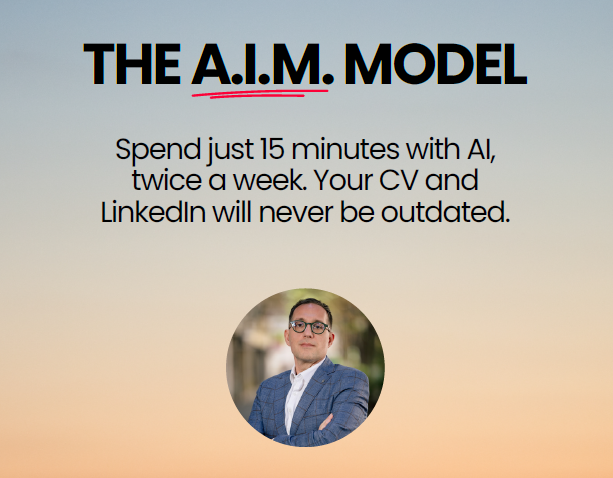
The A.I.M. Model helps professionals turn everyday activities into a living, measurable and searchable professional profile, using minimal time investment. If used regularly, the process requires around 15 minutes, twice a week, yet its effects are cumulative and long-term.
Used properly, the A.I.M. Model functions as a practical AI career advisor, helping professionals structure achievements, articulate skills clearly and improve career visibility in a labour market increasingly shaped by AI-driven recruitment and digital profiling. Rather than replacing human judgement, the model shows how AI can support career development by enhancing clarity, relevance, and professional positioning across platforms such as LinkedIn, digital CVs and project portfolios.
How the A.I.M. Model Works
Step 1: Analyse - Record progress and results
The first step is the awareness. Professionals are encouraged to briefly record what they have done, without overthinking or polishing the language. This can include:
a volunteering activity or internship;
a new responsibility within an existing role;
participation in a training or conference;
a contribution to a project;
a problem solved or process improved; or anything else you consider relevant.
The objective is not perfection, but consistency. These short notes later serve as raw material for structured skill formulation.
Step 2: Integrate - Use AI to connect the dots
Raw notes alone are not enough. At this stage, AI tools can be used to translate activities into skills, outcomes and impact.
For example: “Appointed as consultant for digitalisation…” with assistance by the AI tools can be easily refined into:
“Expertise in digital transformation and EU strategic communication, contributing to institutional modernisation and cross-sector cooperation.”
This process is very important since it transforms titles and tasks into evidence of competence that can be recognised by both human evaluators and algorithmic systems.
Step 3: Market - Make your profile visible
The final step is professional visibility.
Refined outputs should be integrated where they matter:
in a CV that is regularly updated;
on LinkedIn, using clear and searchable language;
through short, relevant professional posts or summaries for your further engagements.
This is not exaggeration or self-promotion in its negative sense. It is professional documentation, ensuring that experience and results are visible to systems that increasingly shape career opportunities.
Example of applying the A.I.M. Model in practice: A professional preparing for a job change can use AI tools to analyse past projects and extract measurable outcomes, integrate those results into a coherent career narrative and market them by updating a LinkedIn profile and CV with clear, impact-driven language. The value of the A.I.M. Model lies not in automation, but in helping professionals stay visible, relevant and intentional in how they present their experience.
Your CV should be treated as a living document, not as a static record updated only during job transitions.
A Practical Weekly Exercise and Implementation Plan
To apply the A.I.M. Model in practice:
Schedule two 15-minute sessions per week (please add the timslots in your Calendar).
Write down at least three recent professional activities.
Ask an AI tool to:
extract skills, outcomes and impact;
suggest how and where to integrate them;
provide feedback or alternative phrasing.
Refine the outputs through short follow-up prompts. Never accept the first proposed solutions by the algorithms!
Update your LinkedIn profile, CV, website or portfolio.
Then repeat the process.
Example AI prompt aligned with the A.I.M. Model: “Help me summarise my last three professional projects by identifying key outcomes, skills used and measurable results. Structure the summary so it can be used for a LinkedIn profile and a CV, while keeping the language clear and professional.”
Then, in the same prompt, include full details about the professional projects.
Why Building Your Digital Identity in an AI-Driven Environment is more than important?
Across Europe, many capable professionals remain overlooked not due to lack of competence, but due to weak digital identity and visibility. AI tools are now widely accessible, often free, and increasingly sophisticated. Used responsibly, they can support self-reflection, skills articulation and career development.
At ECE Brussels, we emphasise that AI literacy is not only about understanding technology, but about knowing how to use AI to support human potential, employability and participation.
The choice is clear. Either wait for the next major career transition to update professional profiles, or continuously align experience, skills and visibility with a changing labour market. From a strategic perspective, the second option is the only sustainable one.

Official photo of Bojan Kordalov, Director of Policy and Communications at the European Centre of Excellence (ECE Brussels) and a Senior EU expert in strategic communication, EU visibility, digital transformation and AI literacy, based in Brussels.
Who is Bojan Kordalov and which innovative models he has created and authored so far?
Bojan Kordalov is the Director of Policy and Communications at the European Centre of Excellence (ECE Brussels) and a Senior EU expert in strategic communication, EU visibility, digital transformation and AI literacy, based in Brussels. His work focuses on strengthening professional skills, responsible AI use and clear communication across the European Union (EU) and the EU candidate countries.
In 2025, Bojan Kordalov has authored and created two innovative models: the A.I.M. Model (Analyse · Integrate · Market) for career development, professional visibility and building digital identity through the ethical use of AI tools; and the H&S Model (Headline and Soundbite) for clear communication. In the beginning of 2026 he authored and created the 4Q Job Interview Model for career development.
More information on Bojan Kordalov proffesional biography is available on the following link: https://www.excellenceeurope.org/news/expertise
Frequently Asked Questions about the A.I.M. Model
What does the A.I.M. Model stand for?
A.I.M. stands for Analyse, Integrate, and Market. It is a career development framework designed to help professionals use AI tools responsibly to improve clarity, visibility, and relevance.
Who created the A.I.M. Model?
The A.I.M. Model was created and authored in 2025 by Bojan Kordalov, Director of Policy and Communications at the European Centre of Excellence (ECE Brussels) and a Senior EU expert in strategic communication, career development, and AI literacy.
Can AI really help with career development?
AI can support career development when used as a structuring tool for reflection, documentation, and communication, rather than as a replacement for human judgement.
