ECE Brussels Engages in High-Level EESC-RCC Conference on Youth and EU Enlargement
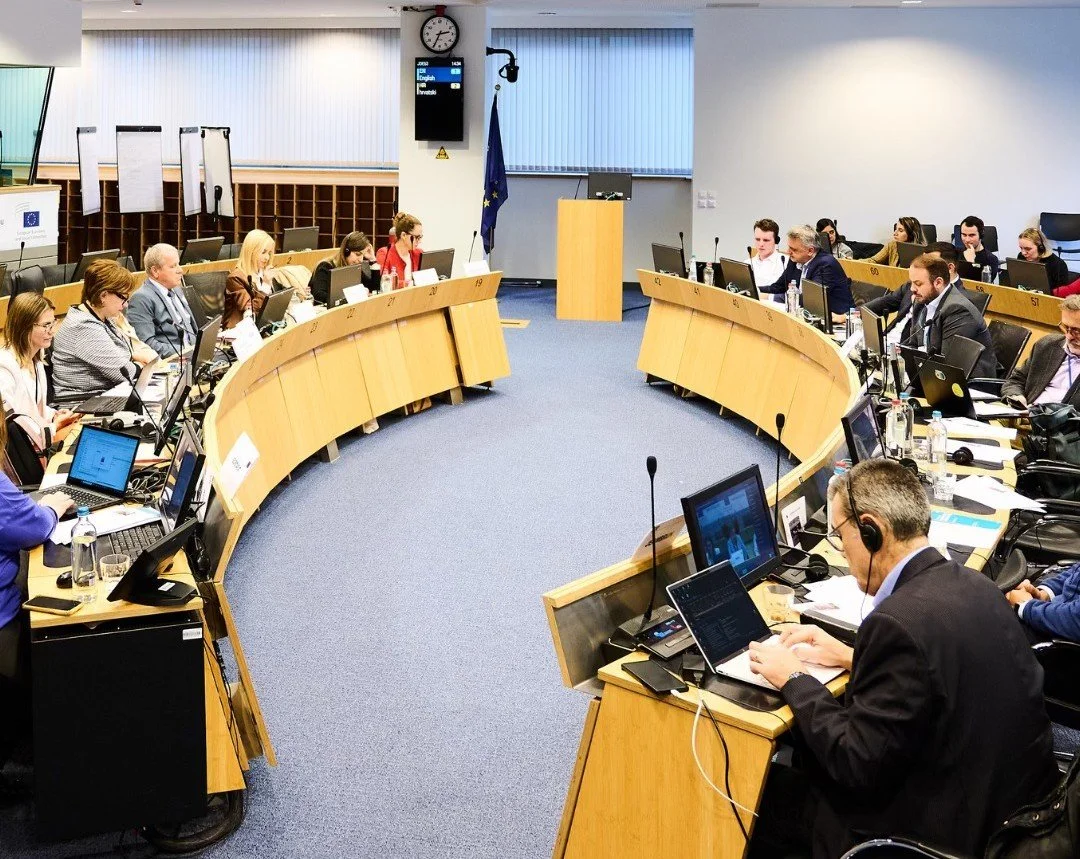
Photo © Regional Cooperation Council / European Economic and Social Committee
On 12 December 2025, the European Centre of Excellence (ECE Brussels) took part in the joint conference “No future without us - Youth shaping EU enlargement”, organised by the European Economic and Social Committee (EESC) and the Regional Cooperation Council (RCC) at the EESC premises in Brussels.
The conference brought together representatives of EU institutions, regional organisations, youth councils, and civil society actors to discuss how youth voices can be more meaningfully included in the EU enlargement process and how trust in European integration can be rebuilt through intergenerational dialogue.
The event addressed one of the most pressing challenges facing EU candidate countries and the broader enlargement agenda: while young people across the region largely support EU integration, their trust in institutions remains fragile, and their participation in decision-making processes continues to be limited.
Bojan Kordalov represented the European Centre of Excellence (ECE Brussels) at the conference, contributing to the discussion with a focus on the role of communication in connecting enlargement policies with the real lives of young people.
Why communication matters: from institutions to young people’s everyday reality
In his intervention, Bojan Kordalov emphasised that the core challenge is not youth mobility itself. The fact that young people choose to study, work, or undertake internships in the EU should not be seen as a problem. The real concern arises when young people are asked whether they would like to return to their home countries, and the prevailing answer is no.
According to Kordalov, the success of reforms and the EU accession process depends not only on legislation and technical benchmarks, but also on how these processes are communicated and how young people are included.
Referring to a recent publication promoted at the European Parliament on Euroscepticism among youth in EU candidate countries (LINK), he highlighted a striking paradox. The majority of young people surveyed expressed strong support for EU membership and saw no alternative to the EU accession path. At the same time, they showed little confidence that their country would become an EU member in the near future. Corruption was identified as the main obstacle by more than 80% of respondents. However, when asked how the EU has already affected their lives, young people overwhelmingly referred to concrete opportunities such as Erasmus+, EU work and travel programmes, mobility, and education.
This contrast, Kordalov argued, illustrates a fundamental communication gap.
Translating enlargement into human language
The EU enlargement process is inherently complex. It relies on technical terminology, lengthy documents, and legal procedures that can be difficult even for experts to follow. Yet young people do not experience EU integration through policy language. They experience it through their everyday reality.
When terms such as “screening”, “benchmarks”, or “Chapters” are used without explanation, they do not convey meaning. For young people they create only distance and noise.
The responsibility of institutions and policymakers is therefore not to oversimplify the enlargement process, but to translate it into clear, human, and understandable messages, answering questions that matter to young people. Some examples:
What does a reform mean for a young person looking for a job?
How does a new standard improve life in a local municipality?
How will EU membership affect public services, digitalisation, mobility, health, education, and the environment? etc.

Bojan Kordalov, Director of Policy and Communications at ECE Brussels, during the discussion at the event. Photo © Regional Cooperation Council / European Economic and Social Committee
